
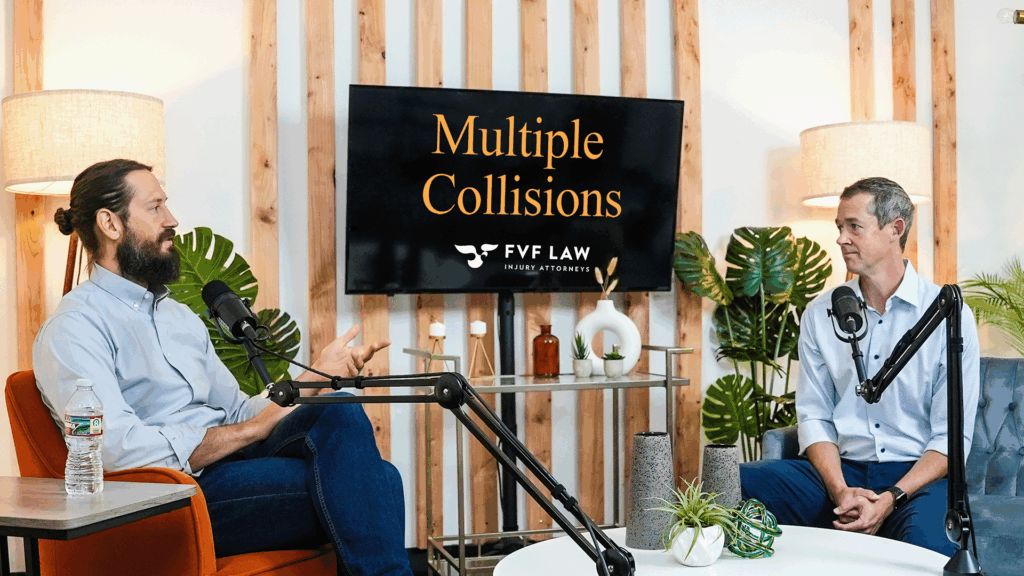
Josh and Aaron unpack why multi-car collisions and pileups are far more complex than typical two-vehicle crashes, from conflicting witness accounts to unreliable initial police reports and the urgent need to secure evidence early. They also explain how limited insurance coverage and “first-come, first-served” rules in Texas make speed, strategy, and underinsured motorist coverage critical to protecting injured clients’ recovery.
Listen here or read the transcript below. FVF’s podcast is available wherever you listen to podcasts including Apple Podcasts, Spotify, iHeart Radio, and more.
0:00:00.2 Aaron Von Flatern: Hey, Josh.
0:00:00.6 Josh Fogelman: Hey, Aaron.
0:00:01.7 AF: Have you ever seen the movie Everything Everywhere All At Once?
0:00:05.6 JF: No.
0:00:06.1 AF: Me neither. But sometimes as a personal injury lawyer, I feel like that’s happening to me. Have you ever had that experience?
0:00:16.5 JF: No.
0:00:17.7 AF: I’m talking about multiple… Let me just cut to the chase. I’m talking about the topic that we’re here to talk about today, which is collisions involving multiple cars.
0:00:28.9 JF: Yes. Pileups.
0:00:29.3 AF: Pileups, multiple people getting injured all at once, and the total chaos that comes from that.
0:00:38.0 JF: Yes, it is chaotic.
0:00:39.1 AF: Let’s talk about it. As a lawyer, how do you deal with that?
0:00:44.4 JF: Yeah, I think why we wanted to kind of talk about this topic is because in many ways multiple car collisions or pileup collisions are different in the way that they have to be investigated and handled than automobile collisions that involve, you know, two cars colliding or a car colliding with a pedestrian or a cyclist or something of that nature. And there are some complications that have to be considered by the handling attorney early in the case in order to secure the best outcome for the client. So, Aaron, can you kind of talk about how are multiple car collisions investigated differently than normal or two-vehicle or less collisions and what are kind of some of the things that we as attorneys need to be on the lookout for when we’re first intaking or hearing a client talk to us about their multiple car collision case?
0:01:49.9 AF: Yeah, so if you imagine a crash that just involves two vehicles or a vehicle and a pedestrian, you know automatically when you pick up that file where the lines are drawn, you know, there’s us and there’s them and it’s us against them. And when there’s three, four, five different vehicles involved, especially if it’s not like linear, it could be an intersectional type of case, all of a sudden you’ve got as, you know, always happens with human memory, you have a lot of different narratives from a lot of different sources. Some of them are on your side, some of them are not on your side, some of them seem like they might not be on your side but they turn out to actually help you. And so you have to, in my opinion, as a lawyer, the first thing you have to do is get super objective and start to make real assessments about what evidence is out there and how to categorize it and how do we get more of it? And so maybe I’ll turn it back over to you on, like, what is the process for trying to get the information.
0:02:53.1 JF: Yeah, like you said, there’s a lot of finger pointing that can go on. And what I have noticed having dealt with these for the last 16 years or so, is you can’t always trust the police report that you get that puts the blame on one person or multiple people. I’ve seen more than most other types of car collisions, I’ve seen more police reports revised ex post facto after the fact by the police in multiple car collisions than in any other type of case. And that’s simply because you’ve got a number of different affected parties oftentimes coming forth and telling stories that just don’t make sense. One of the things that, you know, can be really important in pileup cases where you’ve got just like a linear collision are, when did the impacts occur, how many impacts did each person feel? And you see the police doing their best to try to investigate these cases and try to reverse engineer the sequence of events, and oftentimes there are just inconsistencies in what the people are saying they heard and felt and experienced that make it impossible for the police to come up with a story that really makes sense.
0:04:16.3 JF: So to your point, what is critically important oftentimes is to identify whether there might be any surveillance footage in the area that caught it on film. A lot of people are using dash cam videos these days to make sure that you try to capture any dash cam video. Identifying witnesses that might have actually observed the event occurring, but that weren’t involved in the pileup can be of critical importance. Sometimes that comes from reaching out to the public records department, reaching out to the city or the county or the state to get actual recordings of 911 phone calls to chase witnesses down. And of course, in some cases you want to actually secure and preserve the vehicles that were involved and get an expert out there who can download the data to understand impact speeds and timing of things, to try to put together and create a coherent story out of what can oftentimes be an incoherent set of information.
0:05:22.1 AF: Yeah, someday I think it will be true that all human movement in all directions is basically all recorded by a combination of technology and AI, you know, synthesizing where our phone is and sort of all of our movements and all of our transactions and putting it all together into essentially a story where, just like the teleprompter in an NFL football game, you can just kind of hit rewind and see where everybody was and hit play and watch it over and over again. But until that happens, it’s to me an interesting and challenging puzzle to try to put together, especially when your own client has limited recollection.
0:06:08.9 JF: Sure.
0:06:09.1 AF: You know, because it all happens so fast. It always does.
0:06:12.2 JF: Or they get hurt. I mean, badly hurt. And they have to be escorted off the scene, transported to the hospital via EMS or some of the other drivers do. And police can’t get statements from witnesses sometimes for those reasons.
0:06:25.9 AF: Right. And so, you know, you’ve got to kind of figure out, and I think you hit on something very important, which is this question that you and I kind of automatically ask, especially in a linear pileup, which is, you know, how many impacts did you feel? What I think is really cool about that question is most people will answer it before they understand the implications of it, which means you’re getting a pretty good true account of what happened to them, because if someone, you know, felt four impacts, then that implies that one vehicle rear ended them and then got rear ended, and then that vehicle then got rear ended, and then that vehicle then got rear ended. And now we’ve got four different insurance policies that we could potentially stack up to help our clients recover from what might be a surgery or something like that. In other cases, they just feel that one because there’s a chain reaction. And if you’ve ever seen those balls that swing back and forth where you pull one and it hits the others, you know, you get more of that happening and you can only really credibly blame the rear vehicle. And in that case, you just have to hope and pray they’ve got enough insurance to cover the damage that they’ve caused, especially considering it’s not just your client.
0:07:35.7 JF: Right.
0:07:36.0 AF: There’s probably other people. If the energy was enough to reach the front vehicle, if your client happens to be in the front, that means that it traveled through these other vehicles with even more force.
0:07:46.4 JF: Right.
0:07:47.2 AF: So, you know, there’s likely a competition to get to the insurance that’s available, which is in scarce supply. So do you want to talk a little bit about what that’s like?
0:07:58.2 JF: Yeah. That’s another one of the major differentiating factors of multiple car collisions from most two-car collisions is, you know, in Texas, when we’re evaluating or handling a personal injury case, step one is, all right, well, let’s try to find who did wrong, who was liable. And when we do that, we can then understand which different people are insured so that we can identify the appropriate insurance policies that we can pursue on behalf of our client in order to get them compensated for their harms and losses. And when you have multiple car collisions, you’re going to have, in many circumstances, more than two people that are harmed. And because of the way that insurance policies are written, most insurance policies allow payment to a certain amount of money to each person involved and then a dead hard cap at the total number of people involved.
0:09:06.3 JF: In other words, there’s a per person limit in how much they’ll pay to any one individual that’s harmed. And then there’s a per occurrence limit that will pay globally. And when they’ve hit that limit, they’re done. They won’t pay any more money. So when you have three people going after an insurance policy that’s really only set up to pay two people max, the law in Texas says, all right, well, this is a first come, first served situation. And if you’re not at the front of the line utilizing your legal tools that are available under Texas law to, you know, push for recovery of that money, you can get left in the dust.
0:09:47.8 AF: Yes.
0:09:48.5 JF: So trying to figure out what happened and trying aggressively to be at the front of that line on behalf of your clients is frequently more urgent in multiple car collisions or pileup collisions than it is in many other types of incidents when you have three or more people that are injured. And it can also trigger a big question about what available uninsured, underinsured motorist coverage is available. If you want to kind of cover that.
0:10:18.8 AF: I was just going to put in a plug. I think this firm has probably, and you in particular have done more for pushing underinsured motorists in the public eye than other firms because it’s something that you became personally interested in. I know you’ve had some family members who’ve been involved in cases that involved the need to find as much uninsured motorist coverage as possible due to the severity of the injuries. But, you know, and I’ve told my family, and we’re always talking about it, we go on CBS Austin and talk about it. It is extra critical to get underinsured motorist coverage in these types of situations or to have it in place before these types of situations happen. Because as you can see, you may think that the average insurance policy will cover everything, but it’s going to get stretched really thin when there’s multiple cars involved. And then if you have something serious happen like surgery, it’s just, it literally just going to run out really fast. And so you got to turn to your uninsured motors. And the best lawyer in the world is not going to change the insurance limits. It’s a hard stop when they get there. And there’s a very narrow and rare exception that’s not worth kind of getting into right now. The point is, it’s really important to have underinsured motorists in place before something like this happens.
0:11:39.2 JF: Yeah. And when we’re trying to advise our clients in these multiple car collisions, identifying all of the potentially available insurance policies as early as possible is critically important so that you make sure that we put our clients in the best position possible of really getting a fair shake out of the deal because it can get really, really competitive.
0:12:10.5 AF: Yeah. And if you are out there and you have seen Everything Everywhere All At Once, I hope that this podcast, you know, brought you back to that frame of mind. I haven’t seen the movie, but I assumed that this was exactly what it was like.
[laughter]
0:12:26.0 JF: I’m sure they can relate.
0:12:27.6 AF: Yeah. Good talking to you.
0:12:29.4 JF: Thanks for tuning in.